
What Is a Giclée Print?
If you’ve been shopping for art prints, you may have seen the term giclée print and wondered what it actually means—and why a giclée often costs more than a poster, offset print, or standard photo print.
A giclée is a high-quality fine art reproduction created using professional inkjet printing technology. The process is designed to reproduce the color, detail, and subtle tonal variations of an original work of art with exceptional accuracy.
For artists, giclée printing offers a way to create beautiful reproductions of original paintings and illustrations. For collectors, it provides an affordable way to own a high-quality version of an artwork without purchasing the original.
What Does “Giclée” Mean?
The word giclée comes from the French verb gicler, meaning “to spray.” It refers to the extremely fine droplets of ink placed onto paper or canvas during the printing process. Fine art giclée printing combines a high-resolution digital image with professional printing equipment, archival, pigment-based inks, and high-quality fine art paper or canvas. The goal is accurate reproduction of the original artwork, including subtle changes in color and tone.
Giclée vs. Other Types of Art Prints
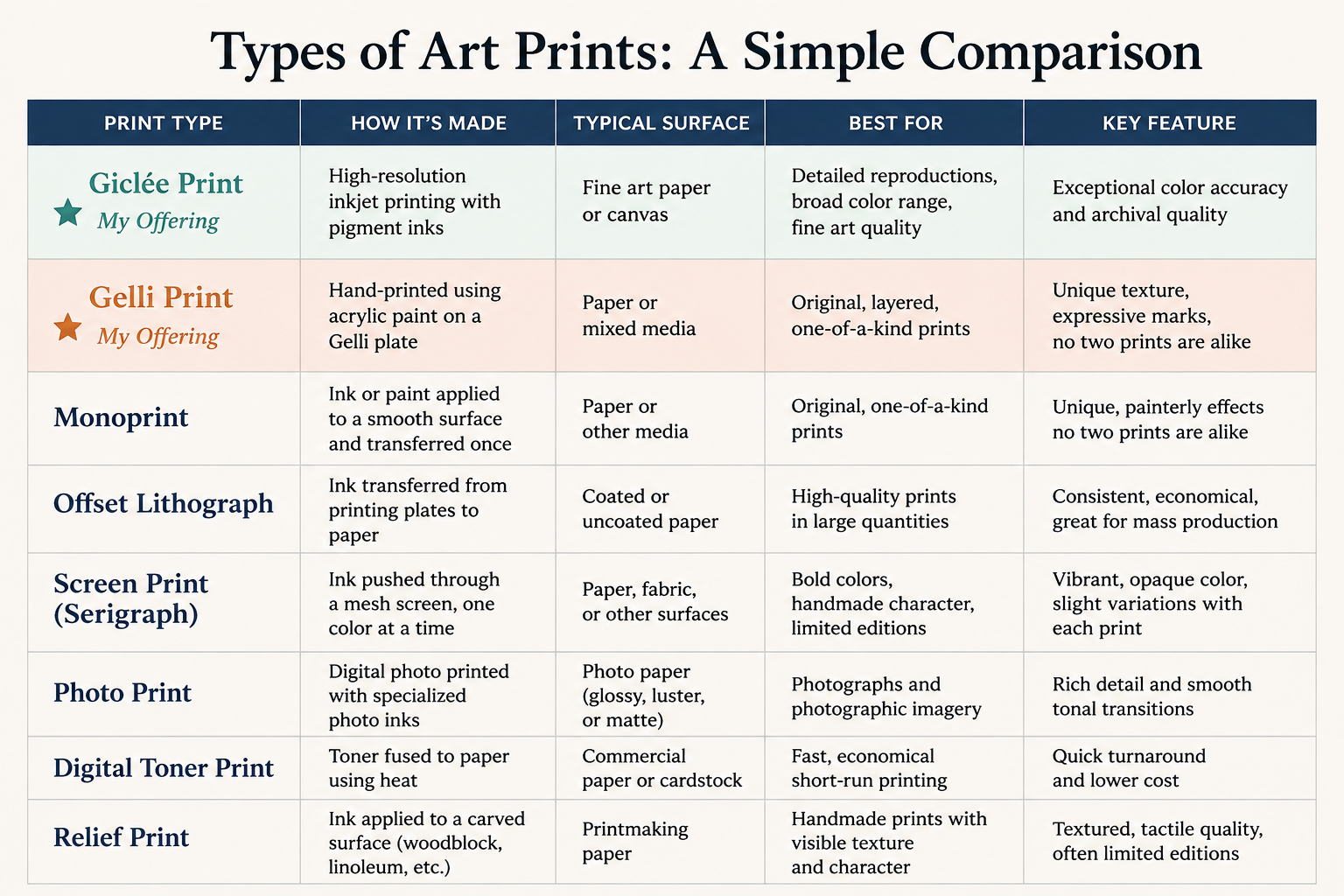
A comparison of a few different types of art prints: giclée, gelli, monoprint, offset lithograph, screen print (serigraph), photo print, digital toner (laser), relief print.
One important distinction: screen prints, woodcuts, linocuts, etchings, and similar traditional printmaking processes can themselves be original works of art. A giclée, by contrast, is generally a reproduction of an artwork that already exists.
Why Choose a Giclée Instead of an Offset or Toner Print?
A painting can contain subtle shifts in color, visible brushwork, transparent layers, textured passages, and small variations that contribute to the character of the original. High-quality giclée printing is particularly well suited to capturing those details.
Offset printing is excellent for books, magazines, posters, and other projects produced in quantity. Digital toner printing is useful for economical short runs. Neither process is inherently inferior—they simply serve different purposes.
For a fine art reproduction, the priority is usually fidelity to the original artwork rather than high-volume production.
Are Giclée Prints Archival?
You will often see giclée prints described as archival, but the term deserves some explanation.
The longevity of any print depends on its inks, paper, printing process, display conditions, framing, humidity, and exposure to ultraviolet light.
High-quality giclée prints commonly use pigment-based inks and archival-quality fine art papers selected for their resistance to fading and deterioration.
That doesn't make a print indestructible. Like original artwork, a fine art print should be protected from prolonged direct sunlight, moisture, and damaging framing materials.
Is a Giclée an Original Work of Art?
No: A giclée reproduction is not the original painting. A giclée captures a high-resolution image of that artwork and reproduces it on another surface.
The original contains the artist's physical marks—the actual paint, brushstrokes, pencil, ink, collage, or other materials used to create the work.
Limited-edition giclée prints are signed and numbered. Open editions are printed as needed. Either can be a high-quality fine art reproduction, but neither should be represented as the original artwork.
What Does the Paper Have to Do With It?
Quite a lot. The paper becomes part of the presentation of the reproduced artwork.
Fine art papers come in different weights, textures, tones, and finishes. A textured matte paper can complement a watercolor or painting differently than a smooth photographic surface.
This is one reason two prints made from the exact same digital image can look noticeably different. The printer, ink, paper, color management, and preparation of the original image all affect the finished print.
What Should You Look for When Buying a Giclée Print?
A good art listing should tell you what you are actually purchasing.
Look for information about the finished size, paper or canvas, whether the print is framed or unframed, and whether it is an open or limited edition. If archival materials or pigment inks are specified, that information can also help you understand how the print was produced.
Buying directly from an artist has another advantage: you are purchasing a reproduction authorized by the person who created the original artwork.
Why Do Artists Sell Giclée Prints?
An original painting can only belong to one collector.
A giclée allows an artist to make the image available to more people while maintaining a level of reproduction quality appropriate for displaying artwork.
It also creates different price points. A collector may love an original painting but not have the budget—or the wall space—for it. A smaller fine art print provides another way to live with the artwork.
Giclée Prints Make Fine Art More Accessible
A giclée occupies a different place from both an original painting and a mass-produced poster.
It doesn't replace the original.
Instead, it allows an artist to reproduce a work with the color, detail, and quality necessary for the image to stand on its own as a fine art print. For collectors, that means access to artwork they love in a format that is beautiful, displayable, and more affordable than the original.